“Nouveau Rambouillet” made by TOYO
Tani here from the Kamiuma shop.
Today I’m writing about the bikes we exhibited at BESPOKED OSAKA the other day.
Since BESPOKED is a handmade bike show, our BLUE LUG booth also needed some special handmade bikes that were different from the bikes we usually carry in the shop, just like the other exhibitors.
These are the two bikes we prepared for the show.

A mountain bike called the FALCONER “Chukar”, inspired by vintage cruisers,
and a rather unfamiliar-looking Rivendell named the “Nouveau Rambouillet.”
Two bikes that, in my own way, are packed full of BLUE LUG’s 20-year history and my own personal obsessions.
At least, that was the intention!
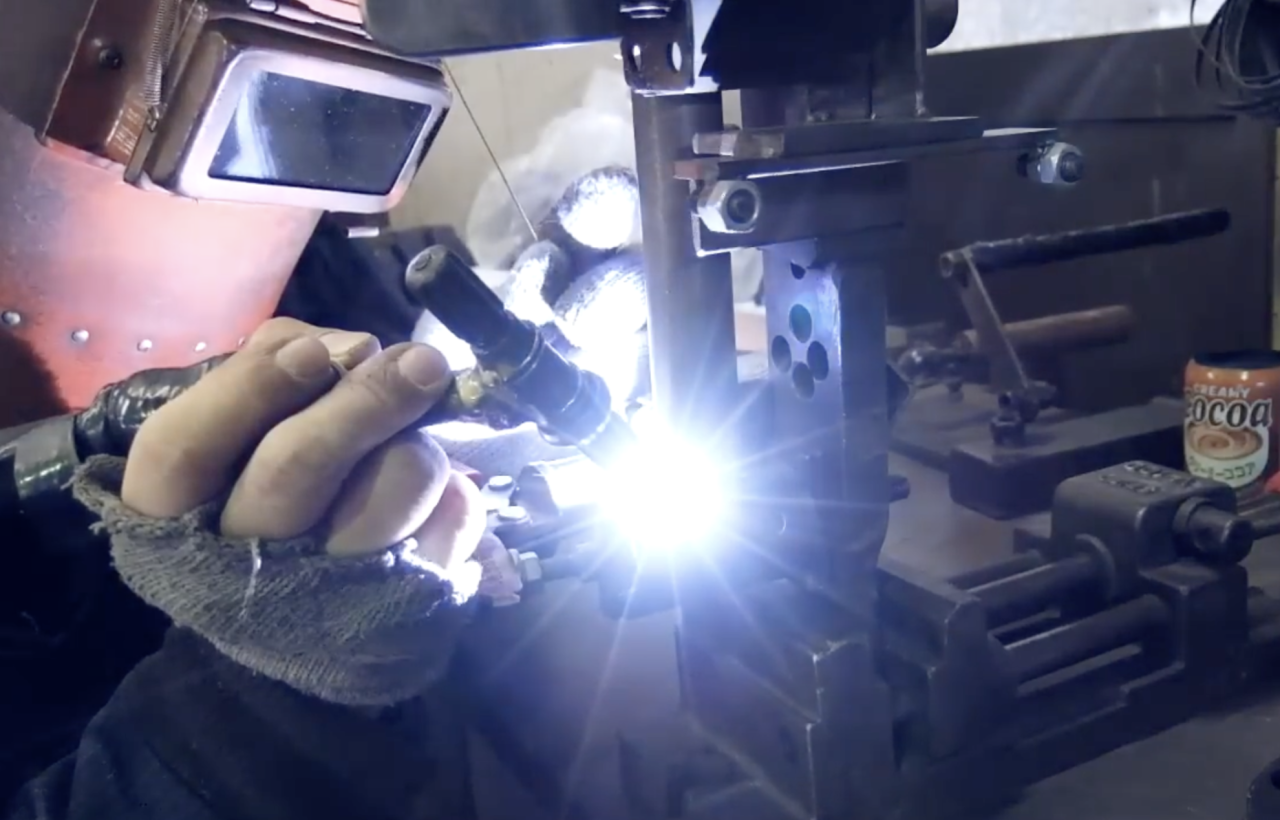
We asked Ishigaki-san of TOYO FRAME, one of Japan’s proud frame builders, to make them.
Handmade bikes, built in Osaka specifically for this show.
Yes, both frames are made in Japan.
BLUE LUG has always leaned pretty heavily toward America, so the fact that we’re showing up to a European-born bike show for our 20th anniversary with two Japanese-made bikes feels kind of funny.
For anyone who’s been riding bikes for a long time, you might already have an idea why we asked TOYO FRAME to make these two bikes.
But let me explain a little about TOYO.
TOYO FRAME is a legendary builder that has been selected to produce frames for some of America’s biggest brands since the early days of mountain biking in the 1980s.
Some famous examples I know are Specialized Stumpjumpers and generations of RITCHEY mountain bikes.
The GT Avalanche, which younger riders are rebuilding and riding again these days, was also made there, and TOYO was deeply involved in the birth of GT’s triple-triangle ATB design as well.
Then in the 2000s, during the period when Rivendell frames were made in Japan, TOYO FRAME was the company building them.
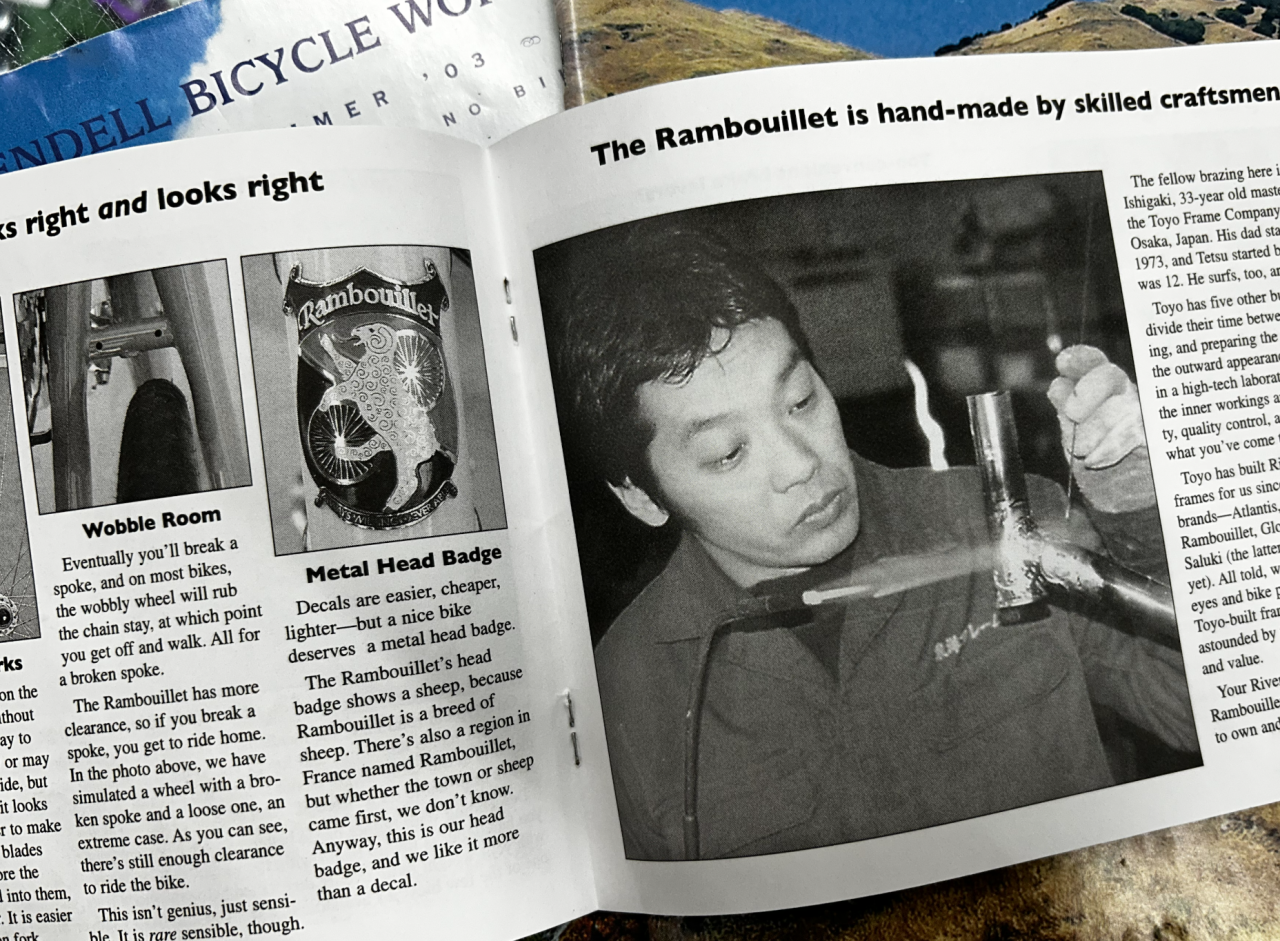
(Catalog from the time)
When Atlantis production could no longer continue in the U.S., production moved to TOYO.
A model Japanese riders may remember from old distributor catalogs is the road model called the Rambouillet.
In Japanese catalogs it was written phonetically as “Ranburetto,” so that’s what I used to call it too.
When I asked Grant about it, he had no idea what I was talking about and was surprised.
Apparently he wants it pronounced properly in French: Rambouillet.
That bike was also made in Osaka by TOYO.
Apparently there were also TOYO-made versions of the BOMBADILL, which later became the Hunqapillar, and the Glorius, which came before the Cheviot.
This “Japanese-made era of Rivendell” still has a lot of fans among Rivendell riders overseas.
Even at the show, a lot of people reacted with things like:
“TOYO made!? Wow!!”

TOYO has been part of the history of Rivendell and American mountain bikes.
So we thought: What if Ishigaki-san, who was making Atlantis, Rambouillet, and Ritchey frames back then, could build a frame again now, using Grant’s latest ideas?

That became the concept behind this show bike: Nouveau Rambouillet.
From here, the behind-the-scenes story of how this bike came together.
We officially found out we would be exhibiting at BESPOKED in late August, while we were in the U.S. for the MADE trip.
The decision came together pretty suddenly, and in the middle of that trip we were suddenly given another mission:
Prepare bikes for the show.
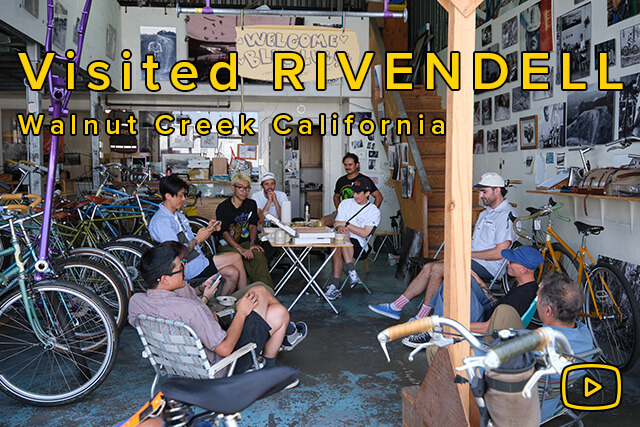
After MADE finished, we returned from Oregon to California and headed to Rivendell.

On the first day, we enjoyed seeing everyone again, filmed Bike Check videos of everyone’s bikes, and generally spent the day hanging around together.
That night, I got a message from the boss back in Tokyo. “There’s a chance Ishigaki-san at TOYO FRAME, who made Japanese Rivendells back in the day, might be able to build us a frame.”
“Could we use that as one of our BESPOKED show bikes?”
My first reaction was: If we can actually make this happen, this is insanely romantic.
But…Will we make it in time?
There were less than two months until the show. Normally you’d spend a year preparing something like this.

The next morning, we immediately brought the project up with Grant. At first he was understandably surprised by how sudden the idea was, but he listened to us patiently.
Though there was definitely a feeling of: “Wait, are you guys seriously going to do this?”
That day we all went out for a ride, and Grant kept talking about the project from the saddle.
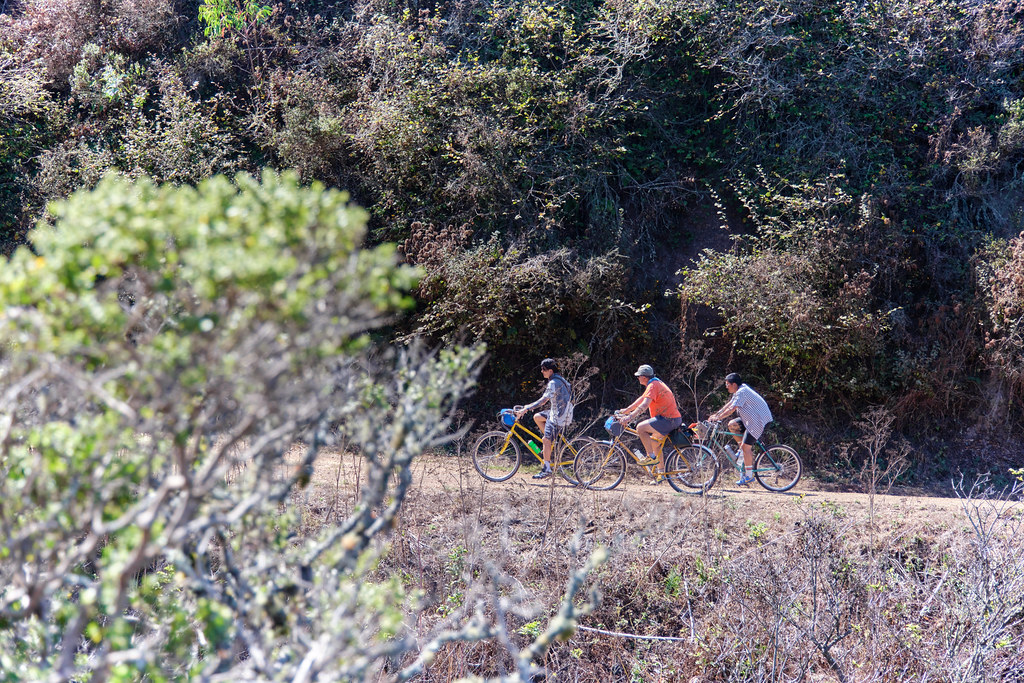
“Why do you want to make it in Japan now?”
We were climbing a brutally steep hill, both of us breathing hard, Grant speaking Japanese and me speaking English, both of us trying our best with broken bits of each other’s languages while having a meeting on the bike.
I tried to explain BESPOKED, BLUE LUG, and handmade bikes while we climbed.
But Will had chosen an amazing route that was also pretty hard, so we never really managed to finish the conversation.
Rivendell frames require a lot of specific materials, including the lugs that connect the tubes and dedicated tubing.
Grant seemed worried that, with so little time, we wouldn’t be able to gather enough of the proper materials to build a frame everyone would actually be happy with.
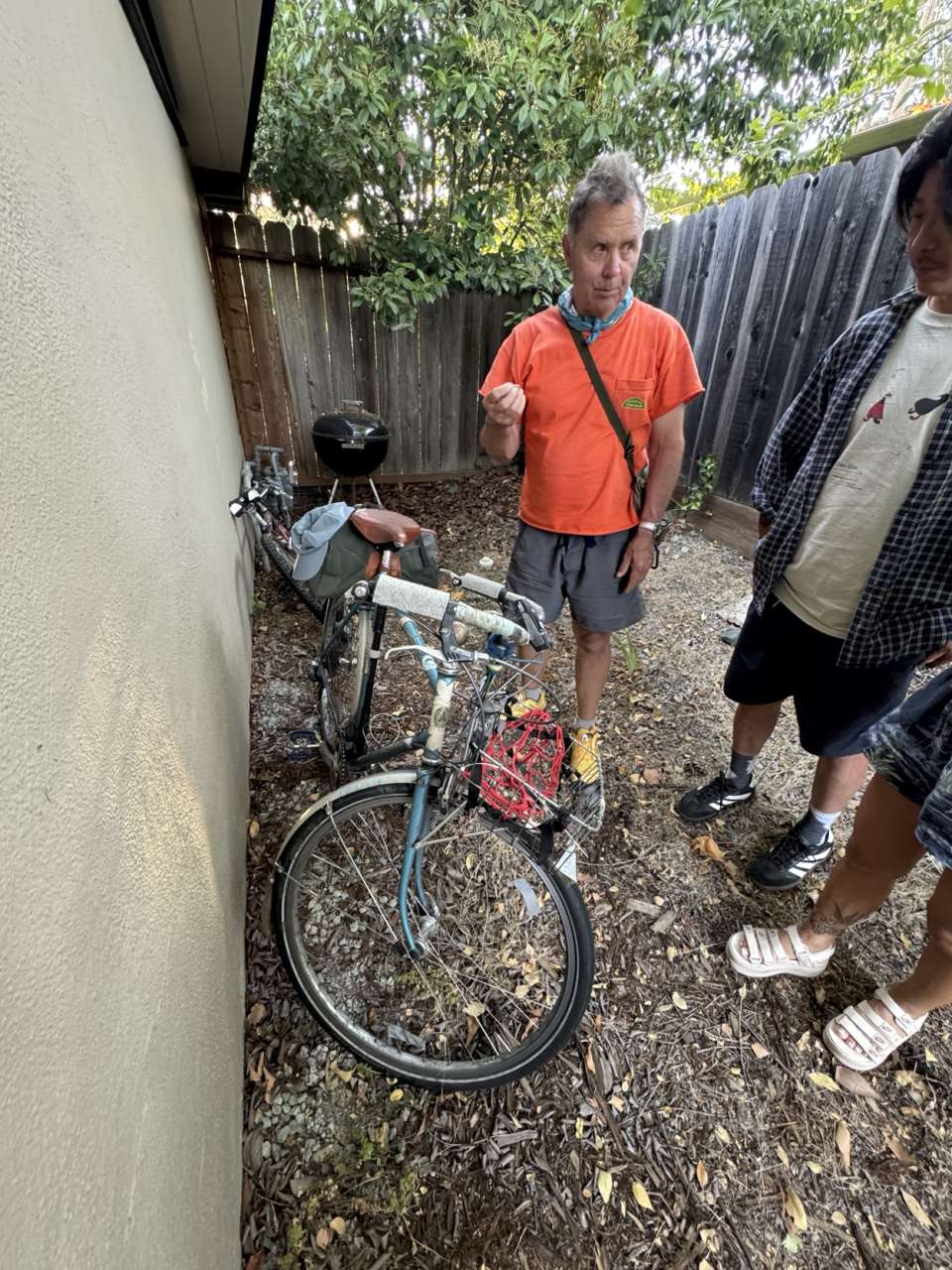
Even after the ride, he listened very carefully to our unreasonable request and gave us advice.
Then he showed us an old Glorius and said: “This one was made by TOYO too.”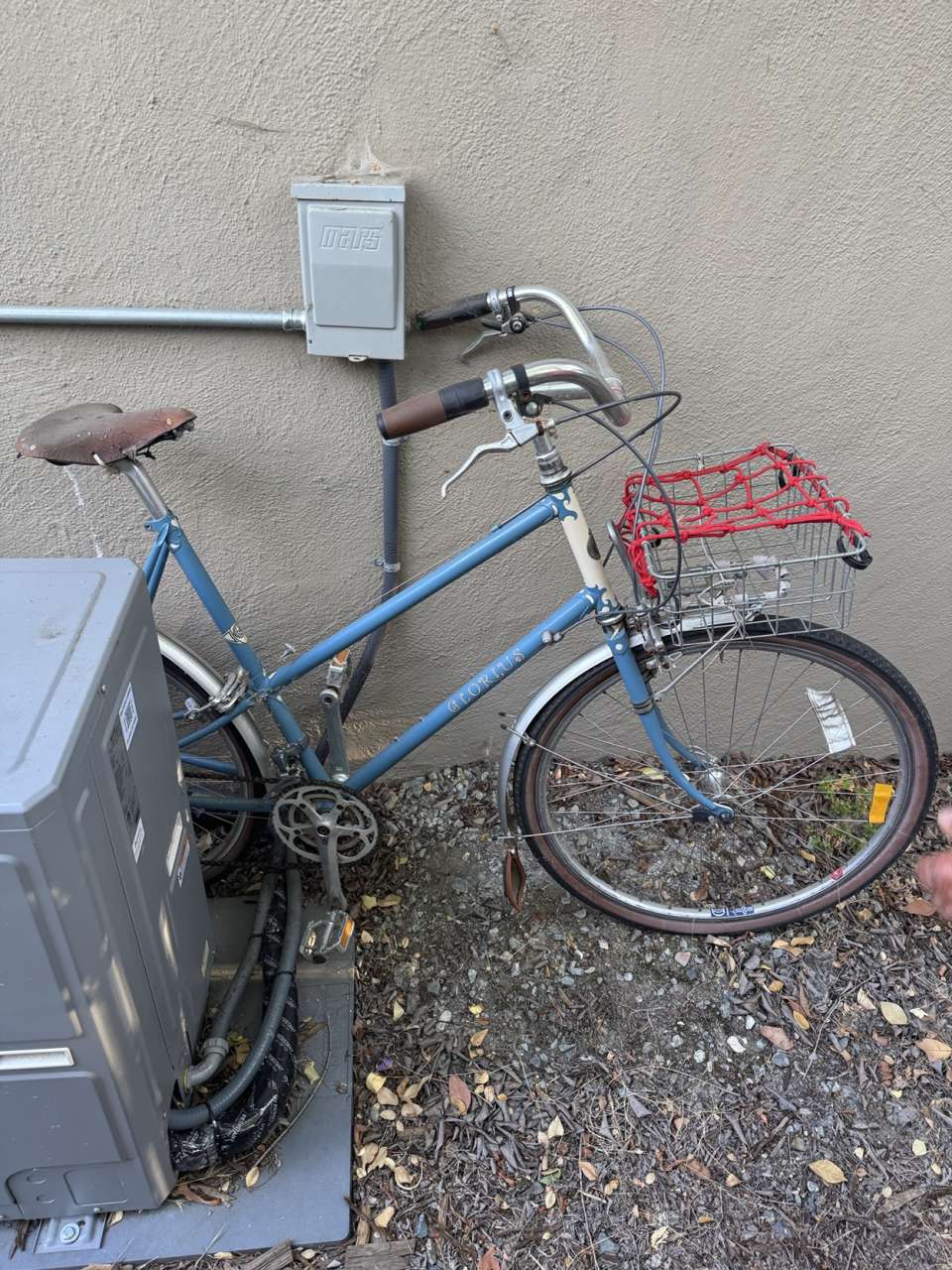
Another thing he kept bringing up until the very end was: “I’m very happy with the quality of the current Taiwan-made Atlantis, and with the people who make them. So is there really a reason to make it somewhere else?”
The discussion carried over to the following day. That night, we ate hamburgers together and called it a day.
・・・
The next morning, we changed our schedule and went back to Rivendell one last time to continue the conversation we hadn’t finished the day before.
When we arrived, all of the Rivendell staff were already gathered in the shop.
It seemed like they had been discussing this project together from early in the morning.
Then longtime mechanic Mark — the person who came up with the M-1 rack! — quietly spoke up.
It was really interesting seeing how much Grant trusts Mark.
Whenever Mark spoke, Grant would stop and listen closely. You could really tell he’d been his right-hand man for a long time.
Mark said: “What about Rambouillet instead of Atlantis? That was another iconic TOYO-made frame.”
He even pulled out catalogs from the time to explain it to us.
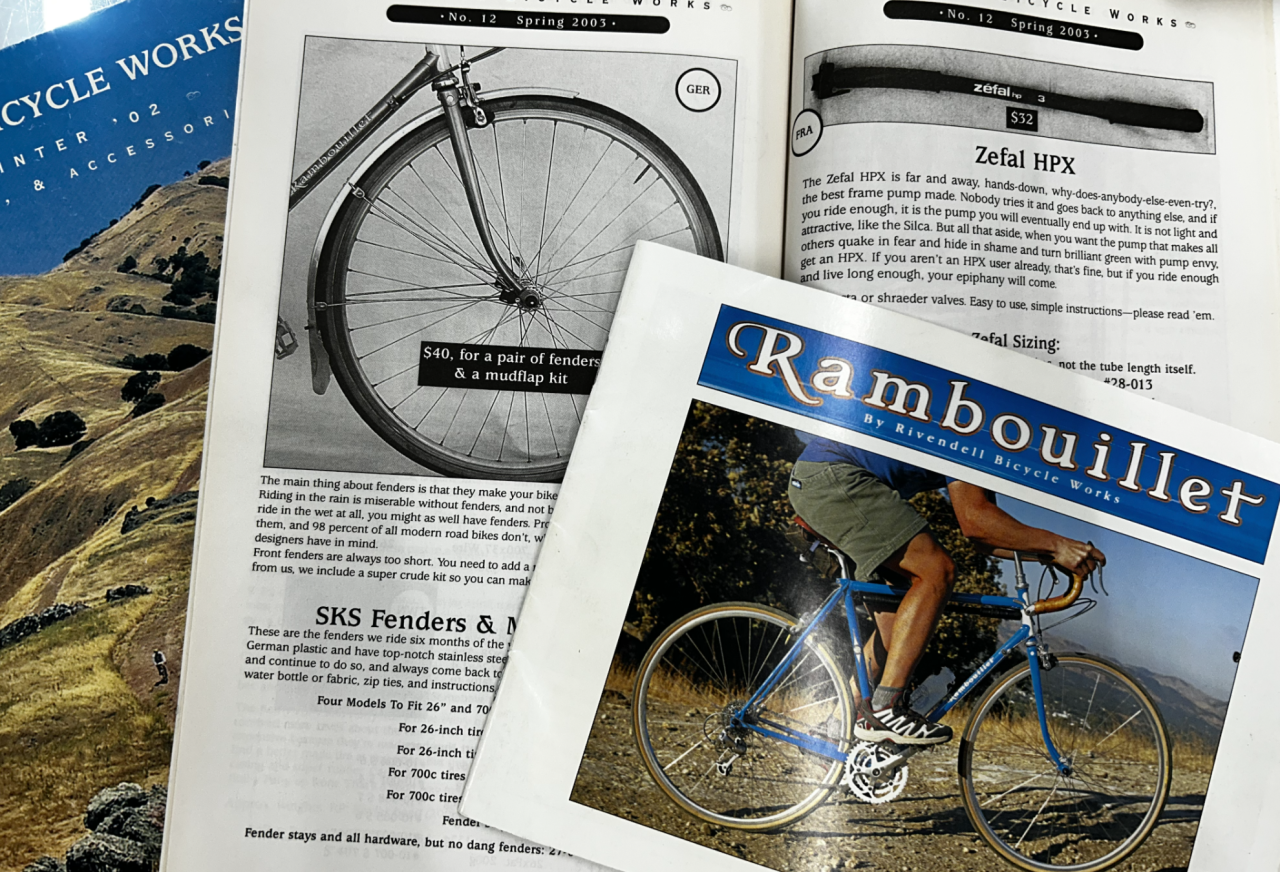
Grant and Mark immediately started bouncing ideas off each other. “If it’s the Rambouillet, which isn’t currently made in Taiwan, maybe that makes sense.”
“Instead of reproducing the old Rambouillet exactly, what if we fix the parts we weren’t satisfied with and update it as a current Rivendell?”
And we were like:“Let’s make a new Rambouillet redesigned with all of Grant’s current thinking!”
“A new Rambouillet… so NEW = Nouveau in French. Nouveau Rambouillet!”
From there, everything started moving very quickly.
…
Rivendell frames are built using lugs, the pieces that join the tubes together. So if you don’t have the correct lugs and parts for the particular frame, you can’t build it.
And Rivendell has countless lugs with different angles.
At that point it became: “Alright, let’s gather everything we need!”
What was amazing was that Grant and Mark could look at a lug and instantly tell you the tube entry angle and tube diameter.
Things like:
“If you use that head lug, the top tube will be at two degrees, so you can’t use that seat lug.”
Or:
“With that combination, the down tube would have different diameters at the top and bottom, so that BB lug won’t work. You’d have to TIG weld it or fillet braze it.”
I thought I knew a decent amount about Rivendell lugs, but I couldn’t even come close.
The people who actually make the bikes and have done it hundreds of times are on another level.
I want to be like that.

The entire Rivendell staff helped us open cardboard boxes all over the warehouse searching for parts.
Thank you, everyone. We couldn’t gather absolutely everything, but they picked out all the parts that might possibly be useful.

We even uncovered an old metal head badge that had never been used on the production version. “There are only two of these, so give it back after the show. Haha.”
After we returned to Japan, Grant sent over a newly drawn design for the bike.
He filled the drawings with detailed notes so that this NEW RAMBOUILLET could actually become a reality, and sent us lots of handwritten instructions as well.
Every single day, he answered our questions and gave us advice step by step, all “for BLUE LUG.”
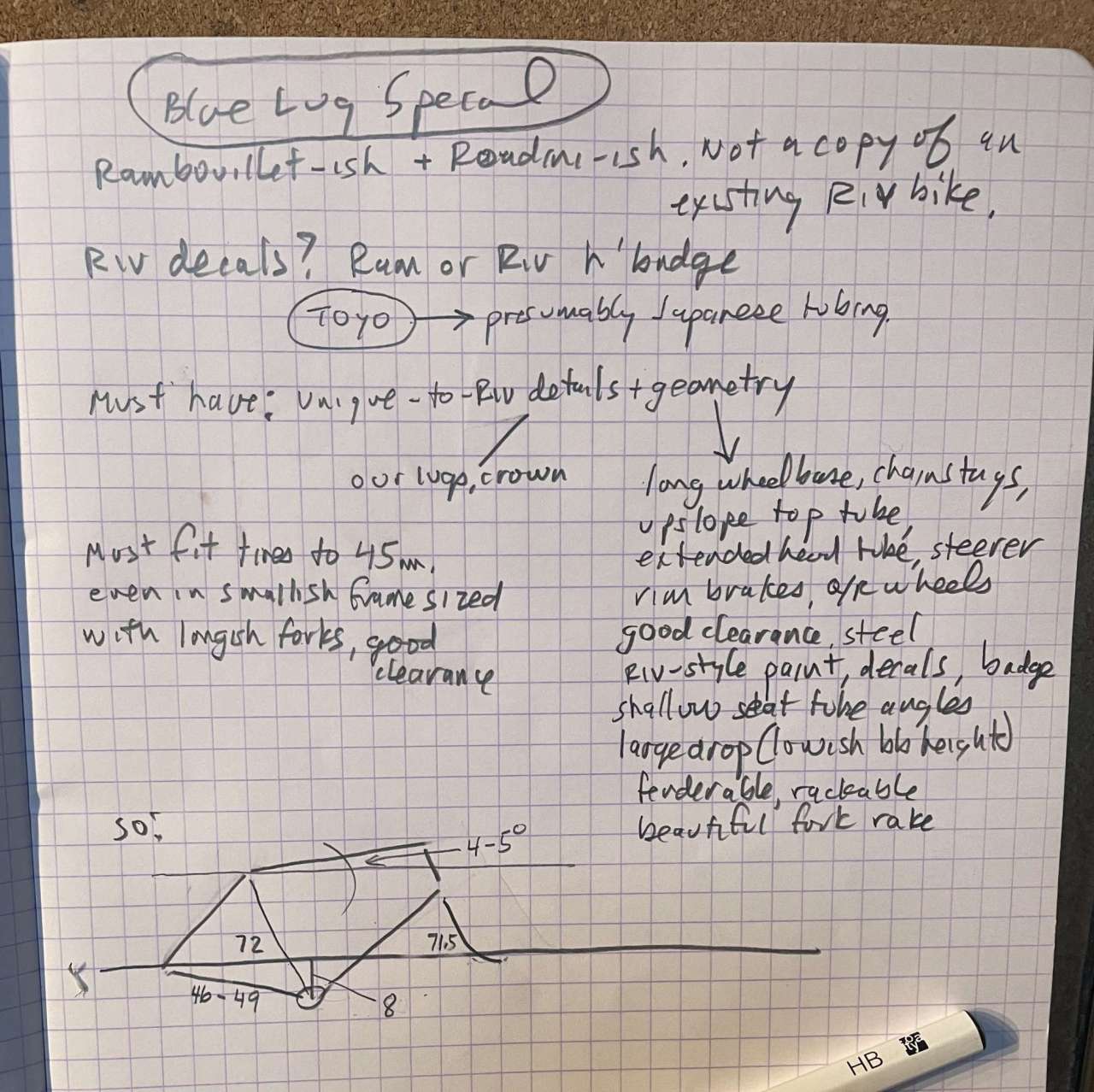
(Here’s one page that seems safe to put on the blog. I want to frame this.)
Every time I opened my inbox in Japan and saw another email from him, I’d literally say out loud:
“Whoa… thank you so much…”
At one point we ran into a massive problem.
One of the biggest differences between Rivendell frames then and now, and one of the most recognizable parts of Grant’s current designs, is the really long chainstay.
But there was nothing long enough available from Kaisei or Tange in Japan. We couldn’t get it.
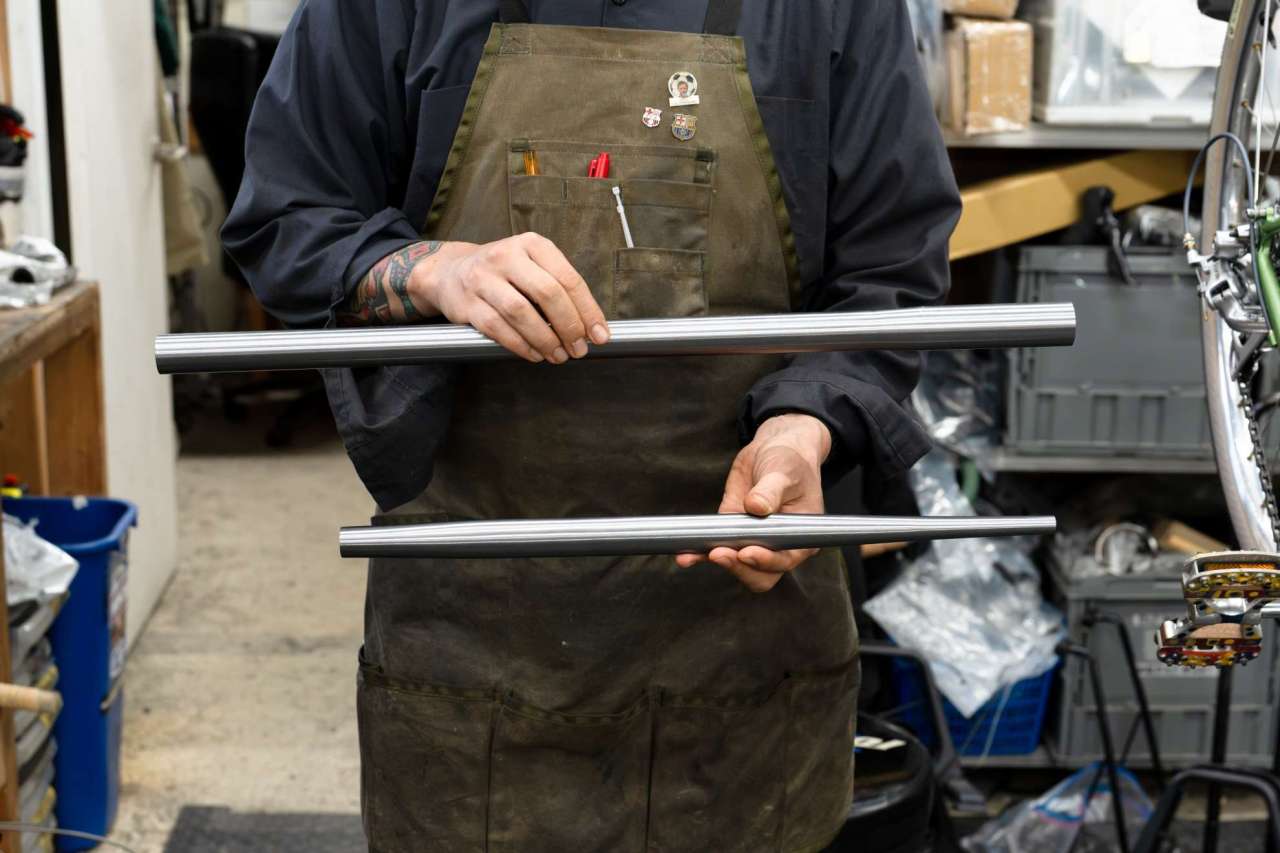
Grant urgently arranged some special Rivendell tubing from Taiwan and sent it over, which saved the project.
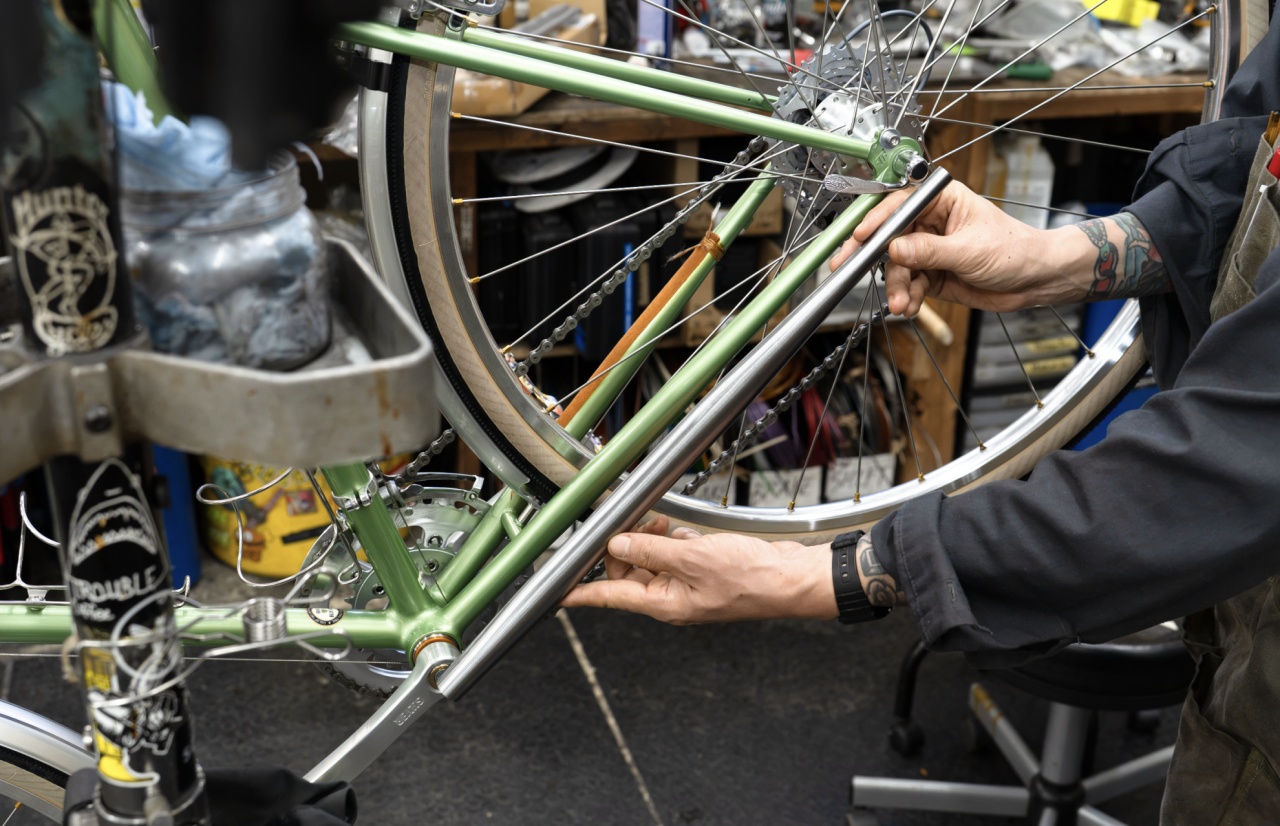
There were other little miracles too.
For example, an old dropout that had been sitting in the display at Kamiuma, something we’d received on a business trip about ten years ago, somehow happened to fit perfectly. One thing I really felt through all these conversations with Grant was just how much thought goes into every detail.
Tube wall thickness. Butting. Where small fittings are brazed.
Every single detail had a reason behind it, and all of it ultimately came back to three things:
Ride quality, strength and safety, and beauty.
Grant is different from a handmade frame builder making a one-off showpiece that looks like art. He’s also a bicycle designer — someone designing something to be produced in quantity and ridden safely by lots of people as an actual tool.
I thought I knew him pretty well by now. We’ve gotten close, and I respect him a lot.
But then it hit me: The person I’m talking to right now is literally the kind of person who ends up in textbooks.
That straightened my back a little. We handed all the parts we had gathered from around the world, along with Grant’s drawings and instructions, over to TOYO. Throughout the building process, TOYO carefully understood what we were asking for.
Then we got the message: It was finished.
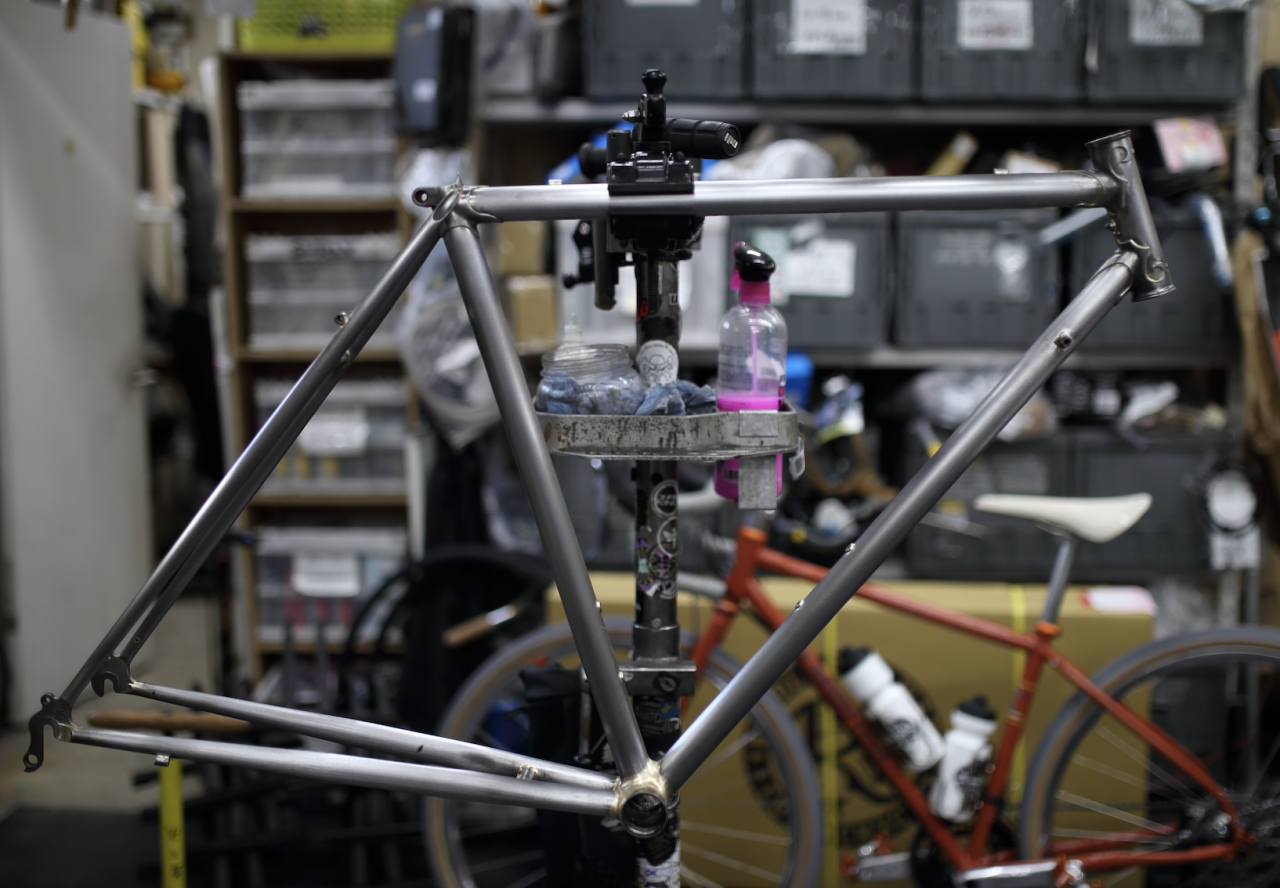
I came into work on my day off, picked up the box, opened it… and started crying.
There was still painting and assembly left to do, but I stood there alone in the pit crying. I’m glad Santa didn’t see me.
And then I was blown away by Ishigaki-san’s work. Thank you so much for agreeing to such an unreasonable build on such a short timeline.
Of course the welding and brazing were incredible.
But what really impressed me was that, despite having to work through someone as inexperienced as me, with everything being communicated remotely like a giant game of telephone, Ishigaki-san understood what Grant and we were trying to achieve — even the parts that weren’t written down in the instructions.
It might sound rude to say this, but: A legend is a legend for a reason. I was honestly moved.
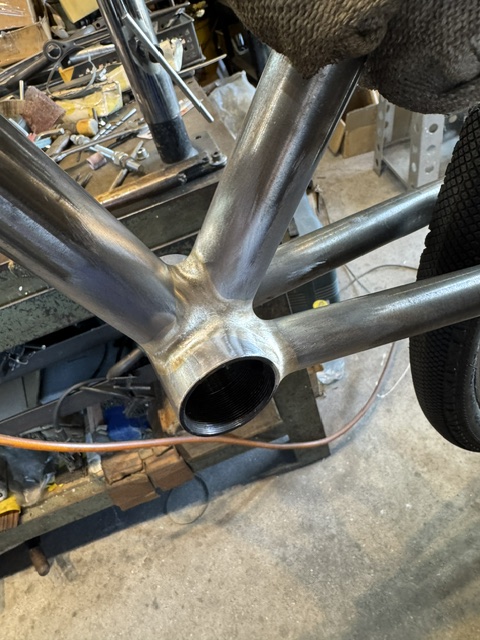
We actually had a BB lug available, but the correct down tube didn’t arrive in time, so they finished the bottom bracket with a fillet instead.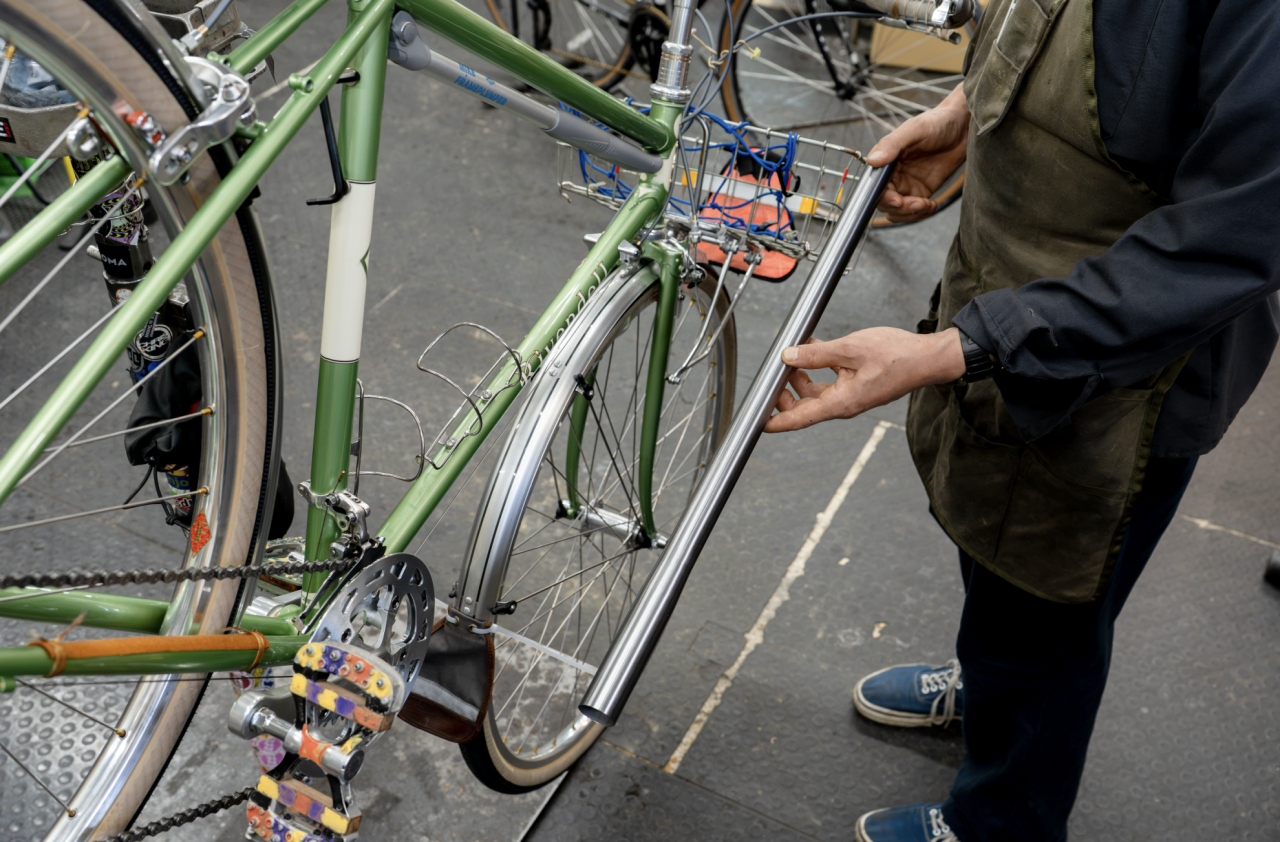
(The down tube that arrived later had an outer diameter near the BB that swelled out like a baseball bat. You can see it in the photo. Grant called it the BBB — “Baseball Bat.” If that had arrived in time, the BB would have been lugged too. But now I really love the beautiful fillet-brazed BB that TOYO made.)
TOYO finished the fabrication perfectly. From there, it was our turn. No pressure.
Less than two weeks until the show.
For paint, of course, we went with COOK PAINT WORKS Konno-Boy.
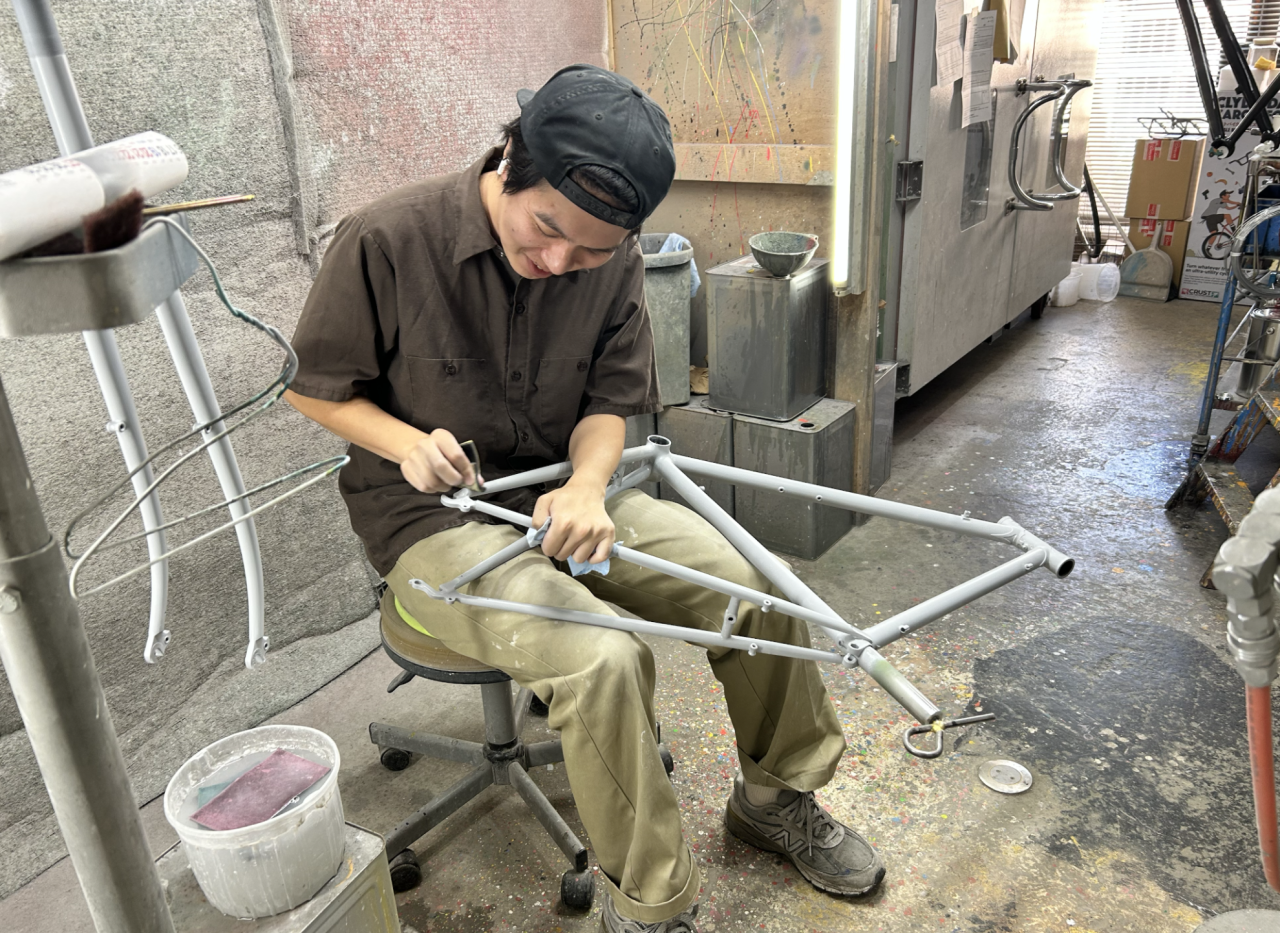
I wanted him to paint it almost like Joe Bell would — without worrying about past Rivendell colors or my own preferences.
The only thing I told him was: “A metallic color that works with a cream-colored panel.” Everything else was completely up to Kon-chan.
I trust his paintwork, so I left it in his hands.
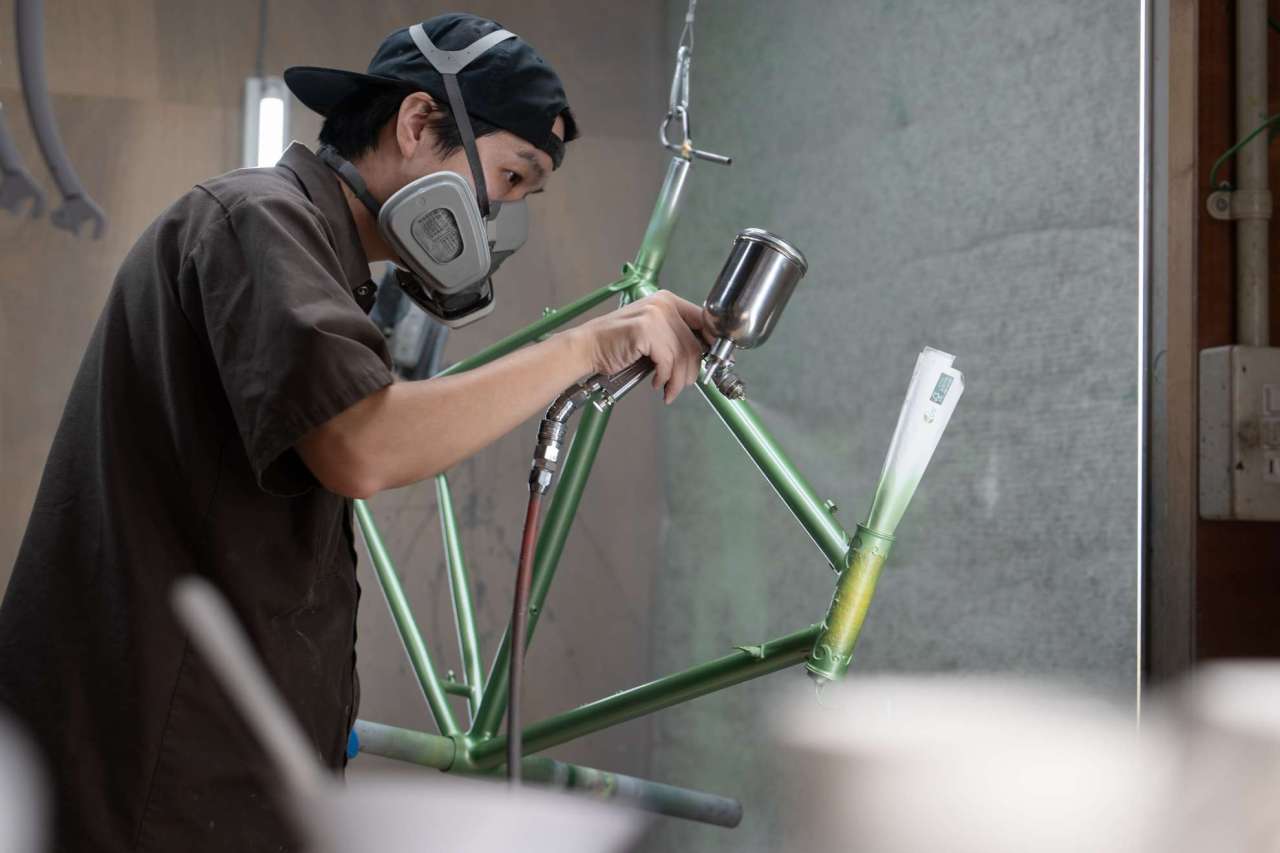
What came back was a beautiful young-leaf green.
Let’s call it: Konno Green.
The Nouveau Rambouillet, made by TOYO.
With the help of a legendary bicycle designer, a legendary frame builder, and everyone at Rivendell, we somehow managed to bring it to life. Ishigaki-san also came to the show, so I was able to greet him and show him the bike after it had been painted and built up.
Ishigaki-san, thank you so much.
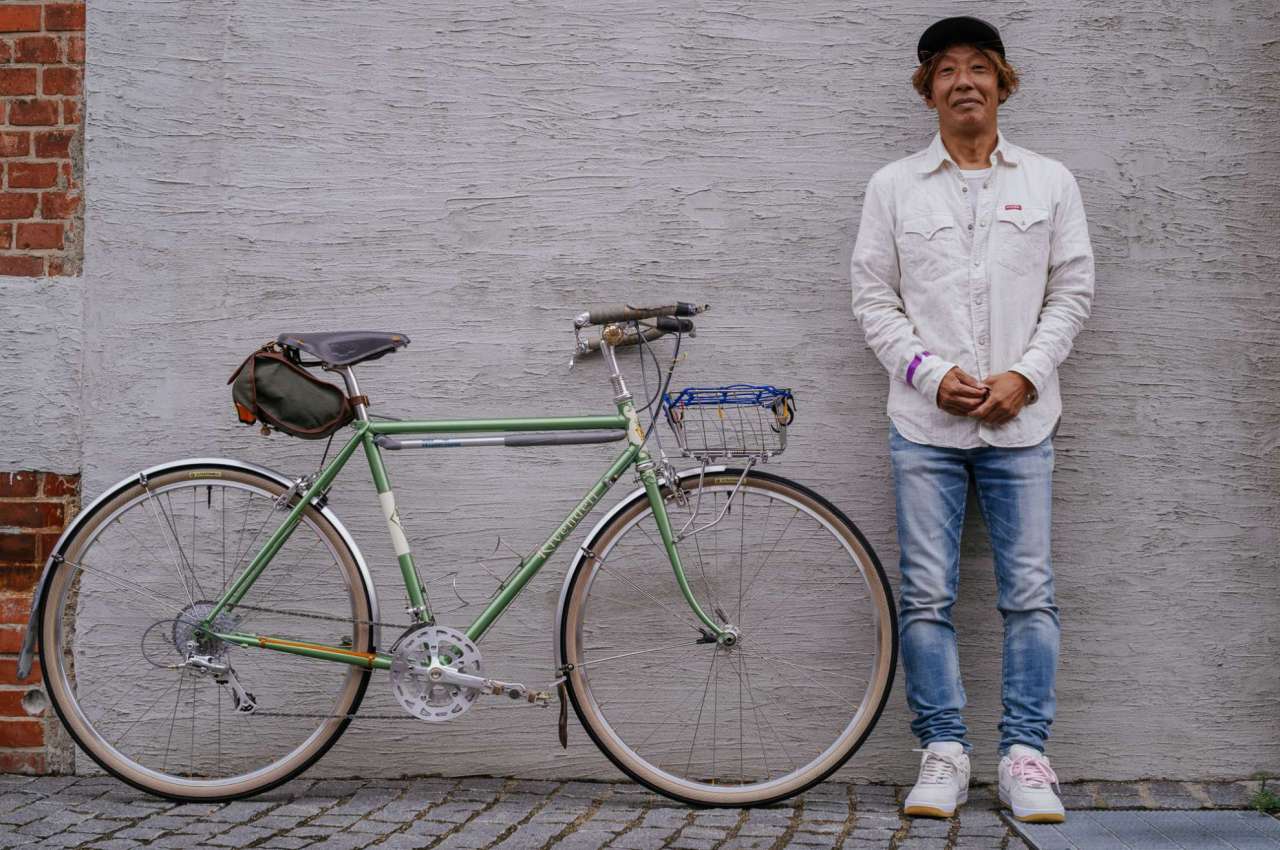
And on top of that, John Watson from The Radavist photographed the bike together with its builder. John owns an old TOYO-made Rivendell himself, so once he found out about Ishigaki-san, he was really happy to meet him too.
After writing all of this behind-the-scenes stuff, everyone is probably going to feel too intimidated to test ride the bike. But if that happened, Grant would probably get mad and say:
“Bikes aren’t for looking at! Ride them! Just Ride!”
And Ishigaki-san, who also builds and supports race bikes, would probably say the same thing. So please come ride it hard.
The actual bike will be kept at Kamiuma. It’s supple, different from both the HOMER and ROADINI, and I’d really like you to experience it for yourself.
And I don’t know yet whether we’ll actually be able to make it happen, but my goal is for this not to remain just a show bike.
I want this to eventually become a product that people can actually buy. That would be my way of giving something back to Grant and Ishigaki-san.
Rivendell’s U.S.-made lineup has now closed, but I’d love for this Japanese-made Nouveau Rambouillet to become a new option.
I want to see these bikes covered in mud from commuting and rides someday. So from here, I’m going to keep working toward that.
From here on is just extra stuff.
If you still have some energy left, please stick around for a Bike Check and some detail shots.
Though honestly, the real value of this bike is everything written above — the miracle and process that led to this frame existing.
My parts selection is just a bonus. As mentioned above, the parts and lugs used on this prototype were a mix of whatever we could gather in time.
It’s a bit of a chimera.
So the production version, if that ever happens, will probably be different. The head lug is one normally used for U.S.-made custom frames.
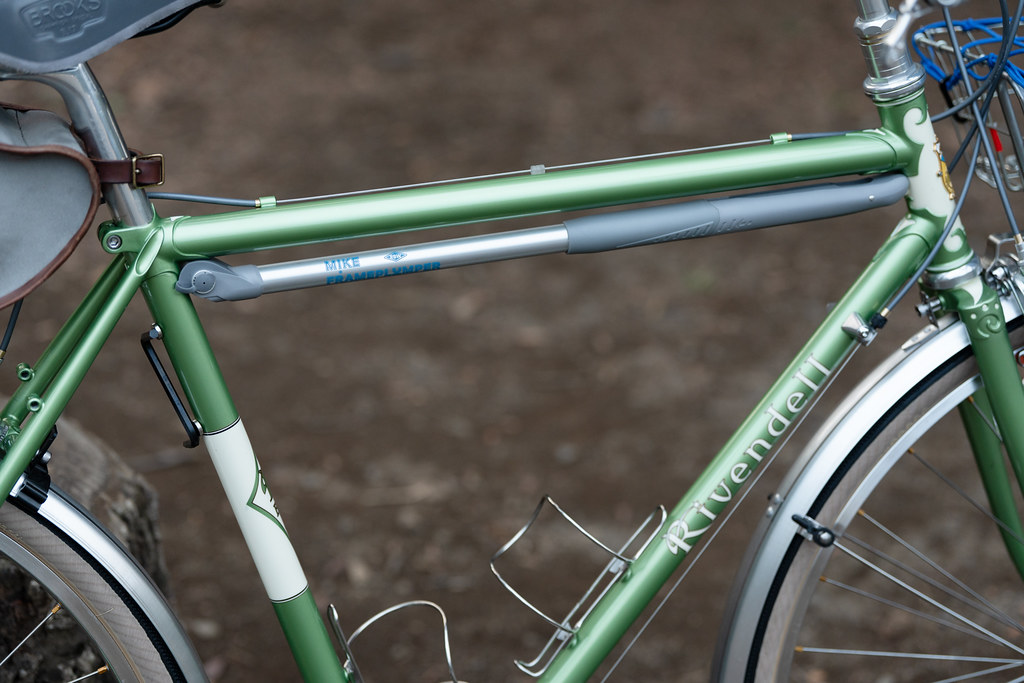
Because of that, the top tube has a gentler slope like older Rivendells. That’s one of its charming details.
People who love older Rivendells tend to care about top tube angle. Personally, I don’t really care either way because I don’t want to lower the handlebar stack.
But we couldn’t get the matching seat lug, so the seat lug on this bike is one that normally wouldn’t be paired with this head lug.

From Rivendell’s usual aesthetic point of view, it’s technically a combination that shouldn’t happen. But on this prototype, I think that mismatch has become part of the charm.
And when we sent the materials to Ishigaki-san, he immediately noticed: “Wait, the head lug and seat lug don’t match. Is that okay?”
That surprised me too. The front triangle uses TANGE tubing prepared by TOYO.

We couldn’t get a “Rambouillet” downtube decal, so we used a Rivendell decal intended for custom frames. If we ever make a production version, I’d love to have a new Rambouillet logo designed for it.
The chainstay is another major difference. The longest chainstay we could source in Japan was 450mm.
This bike needs 490mm. So it was impossible to get locally.
Grant arranged a special Rivendell-made one from Taiwan and sent it to us.

Long chainstays have started to look normal to me because I see them so often now.
But being on the side that had to actually source one made me realize again how unusual they are, and how much extra effort goes into preparing special parts specifically for these bikes.
It made me like them even more. I remain a Grant believer. The longer the better.
The Tani-tector isn’t anything unusual in the Kamiuma pit, but I thought it might be funny to put it on a show bike. Didn’t really get much reaction though.
Tire clearance is another big change from the original, along with the chainstay length. There’s room for roughly a 45mm tire without fenders.

For tires, of course: ULTRADYNAMICO Cava JFF. The tire that turns asphalt into carpet.
I’d just seen Patrick again at MADE, and before even building the bike I had already decided on the combination of a 39c tire with a 45mm plastic fender. Same goes for my ugly homemade mudflap.
I was looking forward to seeing how much it would stand out in the middle of a shiny bike show.

This was an homage to one of my favorite sections in Grant’s book JUST RIDE.
There’s a line about making a mudflap with duct tape and surprising your friends. At the show, two foreign Rivendell maniacs actually came up and asked:
“This is from JUST RIDE, right?” Haha.
The gray leather saddle might still be secret.
Coming soon. There’s a sample at the shop.
As mentioned earlier, the BB was originally supposed to be lugged. But we couldn’t source Grant’s ideal baseball-bat-shaped down tube from Kaisei or Tange in time, so we switched to a fillet-brazed finish at the last minute.
Please take a look at TOYO’s beautiful fillet work.

The BB is PHILWOOD. There are a lot of weirdos at bike shows who crouch down and inspect every little detail.
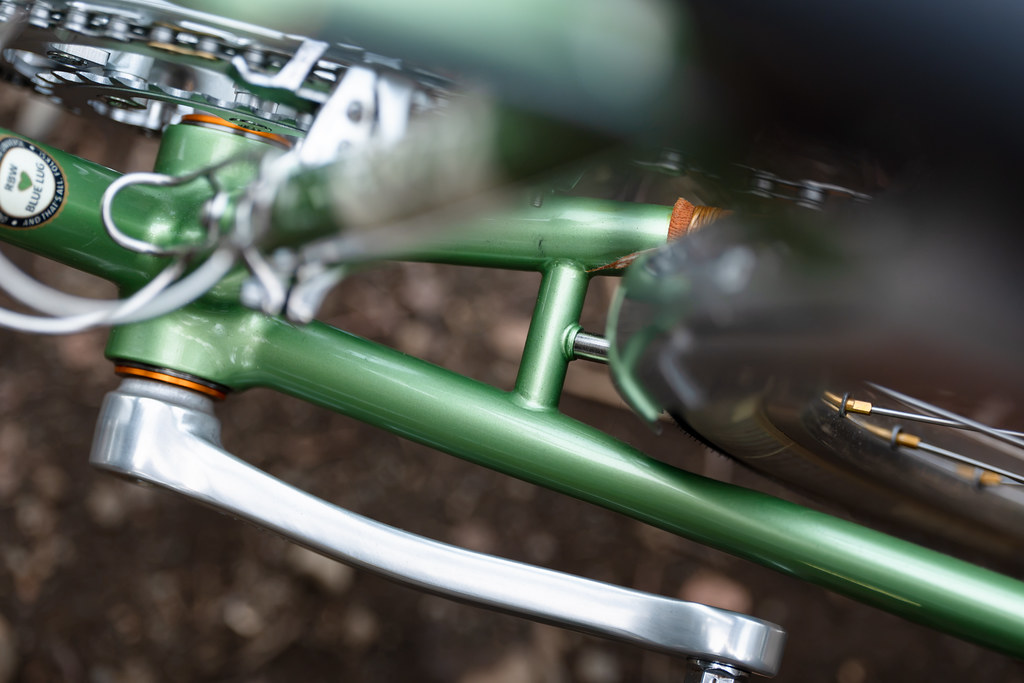
I know because I’m one of them. So I quietly put in a limited GOLD PHIL BB.
No center stand plate, just like the ROADINI. The Rambouillet was originally designed as a “road bike” counterpart to the touring-oriented Atlantis, so I imagine its position was somewhat similar to the current ROADINI.
Like the current ROADINI, I specified single eyelets at the front and rear dropouts, fender mounts only, and no rack mounts.

For the front fork dropout, the only thing we could source was the staggered HOMER-style dropout with an extra rack hole.
That’s what we sent over, so I assume Ishigaki-san cut off the extra section and modified it. I should have painted the tip cream-colored.
That was my mistake. If we make a production version, Kon-chan, please
.
For the rear end, we couldn’t get a suitable Rivendell-made dropout. Grant suggested a hooded-style dropout like the ones used on recent SAM HILLBORNEs, but my vocabulary wasn’t good enough to explain that clearly to TOYO.
So instead, we used a TOYO-made dropout inserted into the stay and finished with a fillet.
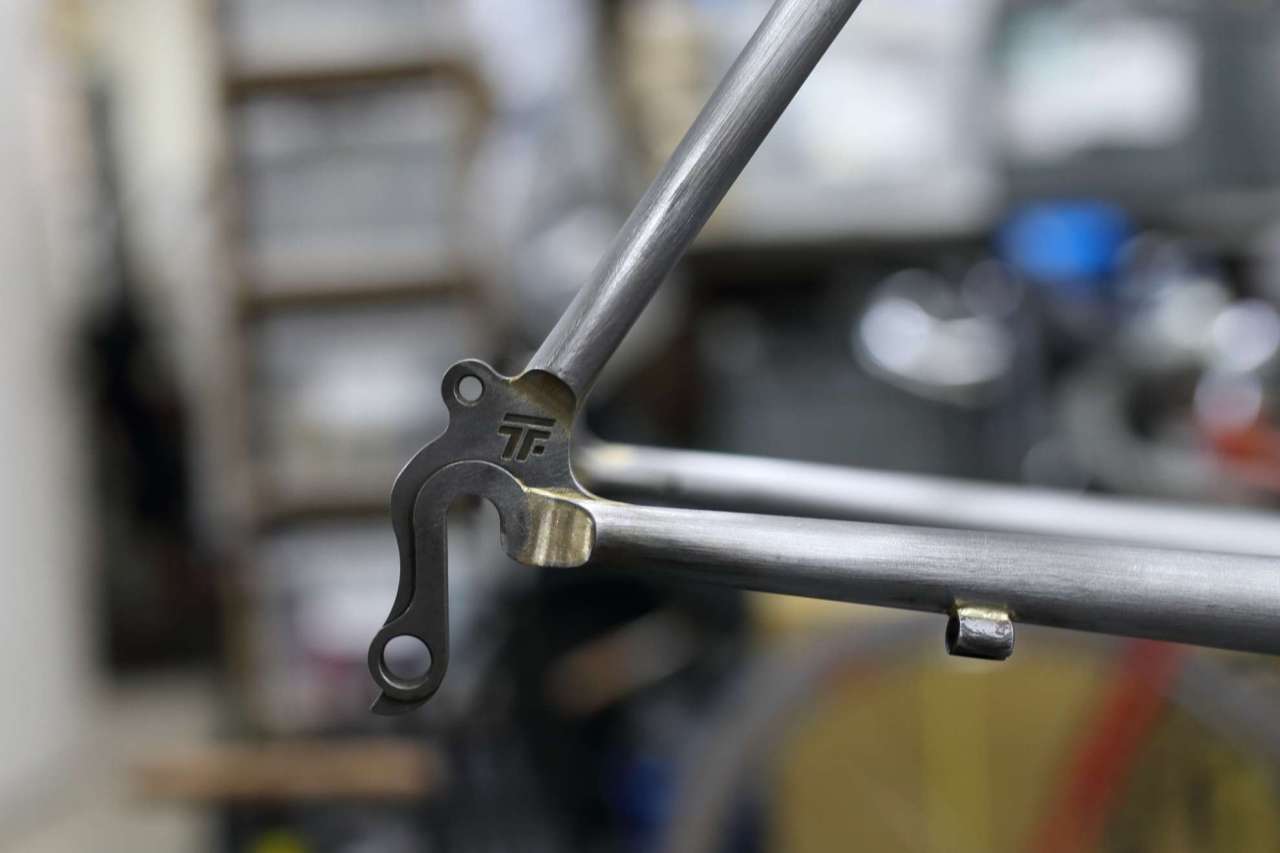
It ended up looking really good. Grant complimented it too.
Not that I can take any credit for that! The hubs might still be off the record.
Instead of polished, I secretly had Matchan send over a special PHILWOOD hub with a brushed finish.
The raw-metal-like texture looks incredibly good.

I doubt many people will read this ridiculously long blog all the way to this point, so I’m probably safe showing it.
I imagine it’ll launch pretty soon. I debated until the very end whether to put the WALD basket on.
The original Rambouillet didn’t have rack mounts halfway down the fork.
And if I wanted to prioritize the original idea of it being a “road bike,” maybe the basket shouldn’t be there.
But then I thought: No. Let’s build the kind of road bike we normally build at BLUE LUG.
So I put it on.

I had already asked for mid-fork rack bosses so that we could at least fit an M-1 rack, which gave me the freedom to change my mind later.
This is probably the one place where my own ego really entered the design. I thought about it a lot.
I also remembered Chuyan complaining years ago because he couldn’t fit an M-1 rack to an older batch of ROADINIs.
And honestly, it feels unnatural for a BLUE LUG bike not to be able to take an M-1 rack.
So now I think it was the right choice.

As for the handlebar, when I think of a Rivendell road bike, there are two choices in my head: Noodle Bar or Albastache Bar.
I went with the Albastache because I figured there probably wouldn’t be another bike at the entire show using one. The top tube is also relatively short, about the same as a HOMER, so the geometry works with either handlebar.

Wool felt plus cotton bar tape. And to finish it off, Grant gave me a pair of his own personally painted pedals.
I wanted to bring a little of Grant’s way of thinking into the show and let bike lovers from overseas see the world of someone I really admire.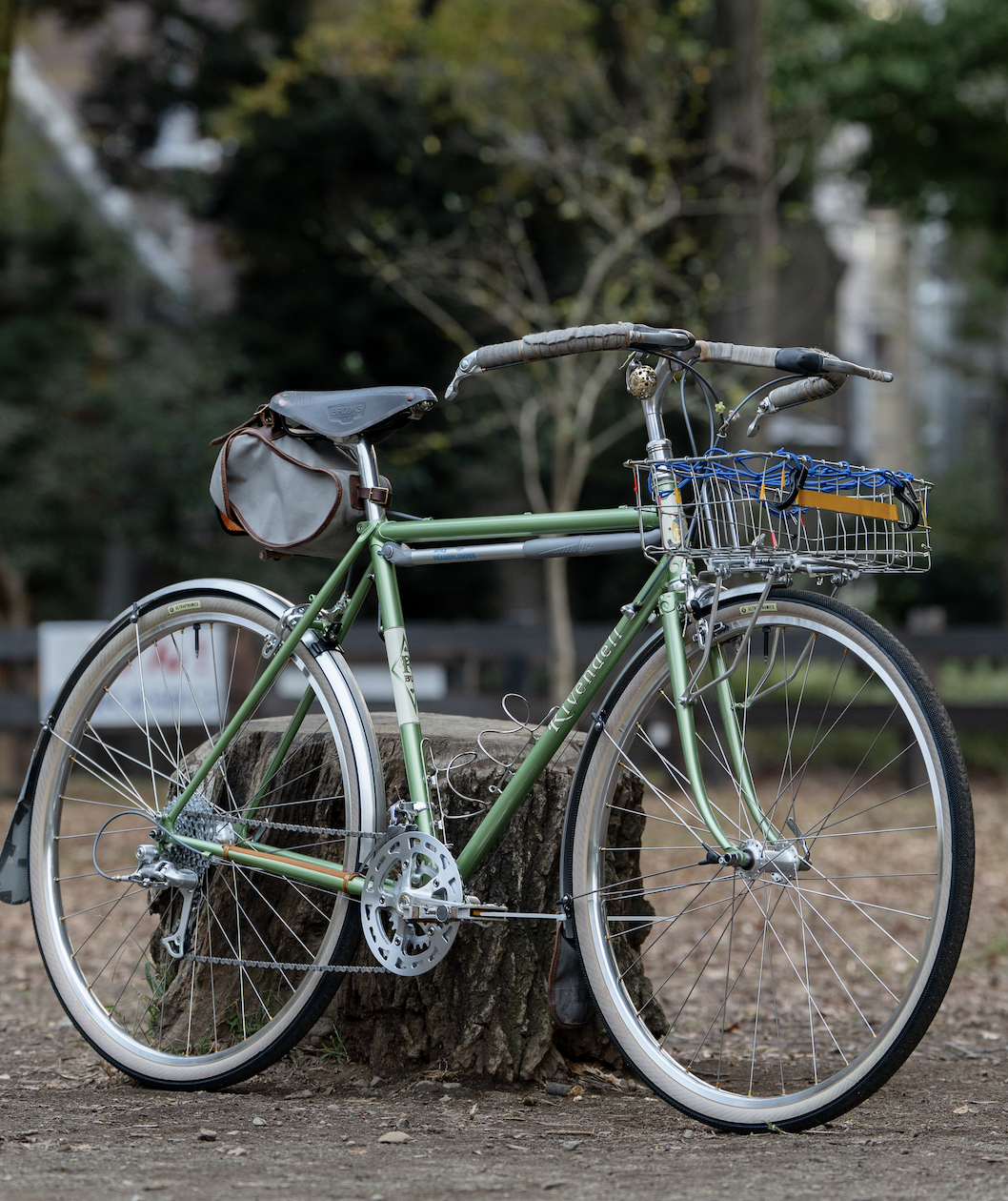
Fenders. Front basket. A handlebar position that doesn’t force you into an aggressive riding posture.
Our version of a road bike.
In other words: An everyday bike.
A 200km ride and a simple bike commute are treated equally. They’re both just “bike activities.”
I don’t know if we managed to express that perfectly. But for BLUE LUG’s first time exhibiting at a bike show, being able to put a Rivendell there meant a lot to me.
As someone who learned so much from Rivendell, it felt like the right way to land.
…
This got really long.
Thank you to everyone who made it all the way to the end.
As expected, I couldn’t fit the second show bike into this post.
I’ll write about that one another day.
Tani